Leaving
Cert Business (Higher) - Exam Guide
(a) Exam Structure &
Strategy
Level
|
Higher
|
Time
|
3 hours (180 minutes)
|
Marks
|
400
|
Structure
|
Section 1 (80 marks)
Short Questions (answer 8 from 10) |
Section 2 (80 marks)
Applied Business Question |
|
Section 3 (240 marks)
Structured Questions (answer 4 from 7) |
- Timing:
Allow 10 minutes to read the paper carefully at the start. This will get
your mind attuned to business terminology, help you to make the correct
choice of questions, and remind you of relevant points (which you can jot
down on your rough-work page). Resist the temptation to launch headlong
into answering questions. Spend no more than 35 minutes on Section 1 short
questions and apply the same time limit to the Applied Business Question
in Section 2. For the structured questions in the final section, allow 22
minutes approx for each of the four questions chosen i.e. no more than 90
minutes in total. Leave 10 minutes at the end to review your paper and
spot any significant errors or items left out. It is tempting to keep
writing furiously up to the final bell, but a nervous mistake made 2 hours
earlier on the short questions or on a financial ratio calculation could
cost you a grade, if not rectified.
- Answering style:
Never write an essay-style answer in Business. Everything should be
structured in point-form. Train yourself to approach every question
with this in mind – what exactly is the examiner looking for here? How
many points should I give? If the number of points required is not clearly
indicated then, as a handy rule, assume 5 marks are allocated for each
point. If part of a question is worth 25 marks, then give five points.
- Make sure you explain or
elaborate on a point, where appropriate. Instructions to
"Explain, Outline, Illustrate, Describe, Discuss" all require
some substantial points of information. Of the 5 marks per point, you will
usually get 2 marks for stating it and 3 marks for further
explanation/discussion.
(b) Walk-through the paper (question by question)
- Tackle this section first,
but do not spend more than 35 minutes on it.
- Definition-type answers are
required, sometimes with examples or illustration. All carry equal marks
and are written in the answer book that is returned at the end of the
exam. Answer all ten questions if you can – you will be marked on your
best eight.
- Because space is limited, think
before you write! Aim to be as precise as possible and do not
write more than the space allows. There are only three or four lines
available for your answer so, if your handwriting is very large, you may
have to modify it for this purpose. Avoid having to scribble out, Tippex,
or rewrite words - it looks terrible and loses you valuable space. Keep
your answer direct and comprehensive within the space constraints. If in
doubt, give a bit more information (such as an example or feature) e.g. in
the 2002 exam Q.1 "What is arbitration?", there were 6 marks for
a definition and 4 marks for some additional information.
- Practice these answers in
preparation for the exam. Use the last three exam papers, sample papers
and your 'mock exam' paper to identify likely terms. It is relatively easy
to get these marks under your belt right at the start and it will give you
a great psychological boost. Each section on the course has particular
terms or definitions worth revising e.g. intrapreneur, interest
group, arbitration, feasibility study, transnational company, total
quality management, etc.
- Two of the short questions
will probably require you to draw a simple diagram or draft some
headings within the box provided e.g. show a type of organisation
structure or a typical span of control. You could be asked to do a basic calculation
of a financial ratio (e.g. debt/equity) or an insurance payment from
supplied figures, and you would need to show your workings. Regularly, the
question will ask you to list some items e.g. three promotional
techniques or five sources of finance, or draft a memo on some
business matter.
Section 2: Applied Business Question (20%)
- You are required to answer a
three-part question based on a text (approx. 300 words), designed to test
your ability to analyse a situation and apply business principles. In the
2007 Leaving Certificate examination in Business at Higher level, the
Applied Business Question (ABQ), will be based on Units 4, 5 and 6 of the
syllabus.
- You must have illustrations
or reference to the text in your answers, even if not explicitly
stated in the question. Thus it is easy to pick up marks simply by making
the most of the information in the supplied text. If you are asked to
outline the enterprise skills displayed by the person (20 marks), identify
up to five skills and select a line of illustration from the text for each
i.e. 5 skills at 4 marks each (2 marks for identifying it and 2 marks for
the text reference).
- You can expect that at least
one part of the question will look for an application of management e.g.
financial management or human resource management and one part will
examine you on an aspect of business in action e.g. marketing products or
expanding the business. In either case, what is needed is a good grasp of
the basic principles which you can then apply to the particular situation.
So, in preparing for the Applied Business Question, don't get weighed-down
with detail but review the main features and then trust your judgement.
- Don't take too long on
individual parts of the question. Make sure you are not wasting time by
giving a long answer to part (a) and then duplicating a lot of the points
in part (b). The marks are not equally divided between the three parts so
allocate your time and efforts accordingly.
- Be careful when interpreting
the question. Keep asking yourself – what exactly are they
looking for here (Management skills or management activities? Market
research or product development?). How many points should I give? If there
are more marks available for a particular part, then the points should be
developed more fully. A good approach is to name, explain and apply
i.e. state the point clearly, describe or explain it, and then show how it
relates to the circumstances outlined in the supplied text.
Section 3: Structured Questions (60%)
- You are required to answer
four questions from seven, at least one from Part 1 (Unit 1 - People in
Business/ Units 6 & 7 – Business Environment) and at least two from
Part 2 (Units 2-5, covering Enterprise, Management, and Business in
Action).
- All questions carry equal
marks and are usually sub-divided into three parts. Your choice of questions
is vital - pick the questions which can deliver the most marks
for you! Carefully examine the three parts, see how the marks
are allocated, do a quick calculation on your potential score, and compare
it with other possible questions. Don't be put-off by what you initially
think the question is asking – you may dismiss a question on financial
management because you hate figures, yet it may turn out to be a very
straightforward non-technical answer that is required.
- Always think 'structure' and
'points' – how many marks going? How many points
should I give? If in any doubt, give a bit more rather than less.
- Remember to state and
explain. Easy marks are lost by not developing the point through
explanation or illustration. If you only state the point and fail to
provide an explanation/illustration/example, you are likely to forego half
the available marks. Be familiar with the outcomes verbs identified on the
syllabus. Know what it means to analyse, distinguish, outline, evaluate,
etc.
- In revising for Section 3,
test your knowledge of specific material on the general course - can you
give four remedies for breach of contract? Can you describe two
long-term & two short-term sources of finance? Can you give five
advantages of branding to a firm? Don't satisfy yourself with mere
recognition - test your recall with a blank sheet of paper in front of
you.
- Review the legislation.
There are seven specific pieces of legislation on the syllabus and you
should know the main purpose & elements of each. Two relate to the Consumer
(1978 Consumer Information Act; 1980 Sale of goods & supply of
services Act), three to the area of Employment and Industrial Relations
(Employment Equality, Unfair Dismissals, Industrial Relations Act). The
others are the 1988 Data Protection Act and the 1990 Companies Act (as it
relates to the formation of private companies).
- Stick closely to your exam strategy & timing. If you are getting bogged-down in a particular section, move on! You can always come back to it. Remember that the biggest 'exam crime' is to leave question(s) unattempted! By making an effort to put something down in each part of the question, you will start picking up marks. The easiest marks to get are the first marks in each part of a question. The hardest marks are the final 15% derived from 'polishing' the perfect answer.
2011
QUESTION AND SOLUTION (Higher level)
(A)
Discuss two possible challenges associated with starting a new business.
(10
marks)
(B) (i)
Draw and label the ‘product life cycle’ diagram.
(ii)
Illustrate the methods a business could use to extend a product’s life cycle.
(25
marks)
(C) As
part of its feasibility study for a new product, Moore Ltd supplies the
following financial
information:
Forecast
Output (Sales) 40,000 units
Selling
Price per unit €20
Fixed
Costs €300,000
Variable
Cost per unit €10
(i)
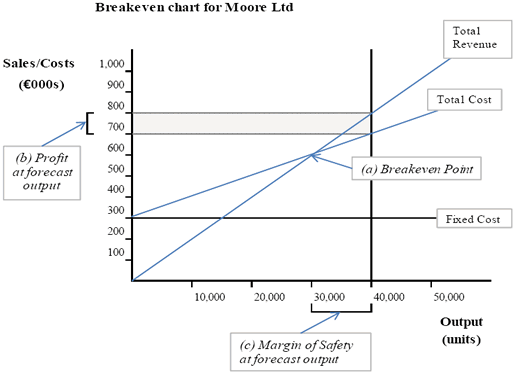
Illustrate by means of a breakeven chart the following:
(a) The
Breakeven Point;
(b)
Profit at forecast output;
(c) The
Margin of Safety at forecast output.
(ii)
Outline
one other
function of a feasibility study for Moore Ltd.
(25
marks)
(60
marks)
ANSWER
Challenges
with starting a new business:
1. Getting finance
It can be difficult to persuade investors to risk their money on a new idea. Before a bank considers lending to a new venture, it will need to see a business plan. The bank will have to be convinced that the idea is viable and that the loan will be repaid.
Also, it may sometimes be necessary to offer equity in the new project in order to get finance. This is a further challenge when starting a new business as equity holders will need to be consulted when strategic decisions are being made.
2. Cash flow
A new business will have to ensure that it does not run out of cash. The start-up phase requires large amounts of finance to keep it going until the product is being sold and cash is coming in to meet its day-to-day expenses. It can be a challenge to maintain the necessary cash levels at this stage.
1. Getting finance
It can be difficult to persuade investors to risk their money on a new idea. Before a bank considers lending to a new venture, it will need to see a business plan. The bank will have to be convinced that the idea is viable and that the loan will be repaid.
Also, it may sometimes be necessary to offer equity in the new project in order to get finance. This is a further challenge when starting a new business as equity holders will need to be consulted when strategic decisions are being made.
2. Cash flow
A new business will have to ensure that it does not run out of cash. The start-up phase requires large amounts of finance to keep it going until the product is being sold and cash is coming in to meet its day-to-day expenses. It can be a challenge to maintain the necessary cash levels at this stage.
(i)
Answer
(i)
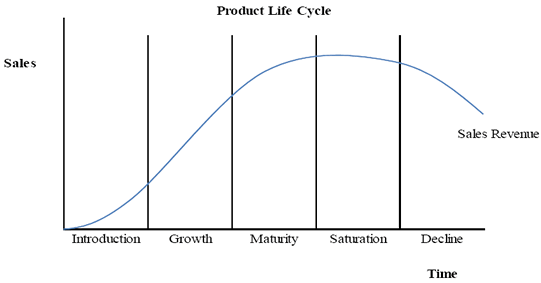
(ii) Methods to extend a product’s life cycle:
· Update the product, for example,
the new features on Apple’s iPhone 4 have extended the demand for the iPhone.
· Increase advertising and
introduce sales promotion techniques such as ‘money off’ offers.
· Reduce price to attract a wider
market.
· Look for other markets for the
product, for example, the export market.
(i)
(i)
(a) Breakeven Point = 30,000 units
(b) Profit at forecast output = €100,000
(c) Margin of Safety = 10,000 units
(ii)
A feasibility study examines whether a new product idea can be successfully developed and brought to the market. If the new product idea is feasible, it means that it can be done profitably.
Moore Ltd could also use the feasibility study to support a loan application if they needed additional finance to develop their new product.
(a) Breakeven Point = 30,000 units
(b) Profit at forecast output = €100,000
(c) Margin of Safety = 10,000 units
(ii)
A feasibility study examines whether a new product idea can be successfully developed and brought to the market. If the new product idea is feasible, it means that it can be done profitably.
Moore Ltd could also use the feasibility study to support a loan application if they needed additional finance to develop their new product.
2010
QUESTION AND SOLUTION (HIGHER LEVEL)
Companies
which invest in marketing in downtimes benefit more when market conditions
begin to
pick up.
(A)
Discuss
the reasons why businesses carry out market research.
(15
marks)
(B)
Evaluate
‘Sales Promotion’ and ‘Public Relations’ as forms of promotion.
(20
marks)
(C)
‘Many
businesses spend large sums of money developing a brand name’.
Illustrate
the benefits of branding for the business
and the
consumer. (25 marks)
ANSWER
Businesses
carry out market research for the following reasons:
a) When developing a new product, market research is conducted at different stages in the process. This helps businesses establish customers’ needs so they can produce products that satisfy those needs.
b) When planning an advertising campaign, market research can help businesses gather information about the target market. This information can be used to help devise an advertisement to which the target market will respond.
c) Market research can provide information on existing products. For example, a business can establish the weaknesses of existing products to discover why sales are falling.
a) When developing a new product, market research is conducted at different stages in the process. This helps businesses establish customers’ needs so they can produce products that satisfy those needs.
b) When planning an advertising campaign, market research can help businesses gather information about the target market. This information can be used to help devise an advertisement to which the target market will respond.
c) Market research can provide information on existing products. For example, a business can establish the weaknesses of existing products to discover why sales are falling.
Sales
Promotion is the
use of short-term incentives to boost sales of a product, e.g. free trial
offers, money-off coupons, etc. While advertising provides a reason to buy a
product, sales promotion provides an incentive to buy a product now. Such
techniques are usually used when:
a) a new product is being introduced to the market and the business wants to generate interest, or
b) an established product has reached the maturity, saturation or even decline stage of its life cycle.
The main aim of sales promotion is to get the consumer to switch brands in the hope that they will continue to buy the brand even when the sales promotion has ended.
Public Relations (PR) involves the creation and maintenance of a positive public image of a business and its products. The aim is to build up goodwill and encourage customers to buy the business’ products. Businesses develop and maintain public relations through such methods as press releases and conferences, sponsorship and charitable donations.
Good public relations can be costly to maintain and it may be difficult to measure the value a business gets from its PR. However, good public relations can create awareness of a company and interest in its products. It can also help generate brand loyalty and build good relationships with the local community. This means that the company would be less vulnerable to sales promotion tactics by competitors.
a) a new product is being introduced to the market and the business wants to generate interest, or
b) an established product has reached the maturity, saturation or even decline stage of its life cycle.
The main aim of sales promotion is to get the consumer to switch brands in the hope that they will continue to buy the brand even when the sales promotion has ended.
Public Relations (PR) involves the creation and maintenance of a positive public image of a business and its products. The aim is to build up goodwill and encourage customers to buy the business’ products. Businesses develop and maintain public relations through such methods as press releases and conferences, sponsorship and charitable donations.
Good public relations can be costly to maintain and it may be difficult to measure the value a business gets from its PR. However, good public relations can create awareness of a company and interest in its products. It can also help generate brand loyalty and build good relationships with the local community. This means that the company would be less vulnerable to sales promotion tactics by competitors.
Branding
is the creation of a brand name, which is used to identify a particular brand.
It is a product name that has been registered with the controller of Patents,
Designs and Trade Marks and is protected against imitation by competitors.
Examples of brands include Barry’s Tea, Guinness and Cadbury.
The benefit of branding for a business are:
a) It develops customer loyalty. Customers who are repeatedly satisfied by a particular brand will tend to continue to choose that brand automatically.
b) It is easier to launch a new product on the market if a company has a good brand name. For example, Cadbury will find it easier to launch a new chocolate bar as it already has an established brand in that market.
c) It helps a company convey a particular image, for example, the Rolex brand conveys an image of luxury.
The benefits of branding for the consumer are:
a) It makes a product more recognisable so consumers can easily distinguish it from the competition. For example, the Nike name and the swoosh logo differentiate their products from the competition.
b) The brand name assures the consumer that the product is of good quality, e.g. Kellogg’s.
c) It helps consumers to choose when there are a lot of options in the market. Research shows that consumers tend to rely on brand names they know and trust.
The benefit of branding for a business are:
a) It develops customer loyalty. Customers who are repeatedly satisfied by a particular brand will tend to continue to choose that brand automatically.
b) It is easier to launch a new product on the market if a company has a good brand name. For example, Cadbury will find it easier to launch a new chocolate bar as it already has an established brand in that market.
c) It helps a company convey a particular image, for example, the Rolex brand conveys an image of luxury.
The benefits of branding for the consumer are:
a) It makes a product more recognisable so consumers can easily distinguish it from the competition. For example, the Nike name and the swoosh logo differentiate their products from the competition.
b) The brand name assures the consumer that the product is of good quality, e.g. Kellogg’s.
c) It helps consumers to choose when there are a lot of options in the market. Research shows that consumers tend to rely on brand names they know and trust.
2009
QUEIONSTION AND SOLUTION (Higher Level)
Olympian
Ltd is a company that produces a range of high quality branded sportswear.
Following a
lengthy
market research process, the firm is now expanding its business to include a
new range of
Hoodie
Tracksuits, aimed at the teenage market.
(A)
Outline
the stages involved in the development process of the new range of Hoodie
Tracksuits.
(20
marks)
(B)
(i)
Explain the term ‘market segmentation’, illustrating your answer with reference
to
Olympian
Ltd.
(ii)
Outline
two
benefits to Olympian Ltd of segmenting the market.
(20
marks)
(C)
Describe
the factors that the Marketing Manager of Olympian Ltd should consider when
deciding
on the selling price of their new range of Hoodie Tracksuits.
(20 marks)
ANSWER
A.
The stages in the development of a new product range are:
1. Idea Generation - This identifies various product ideas. This can result from brainstorming or from market research as is the case of Olympian Ltd.
2. Screening Ideas - A SWOT analysis should be applied to identify ideas with potential.
3. Concept Development - A detailed version of a new product idea should be developed. This should identify its unique selling point.
4. Feasibility Study - This is done to check that the new product can be successfully developed and brought to the market. A break-even analysis is done to check if the product can earn profit.
5. Prototype Development - An original working sample of the product is developed and tested.
6. Test Marketing - Consumer feedback is gathered at this stage.
7. Commercial Production and Product Launch.
B.
(i)
Market segmentation means dividing a market into similar groups of customers, where each group or segment is made up of customers who have similar expectations of a product.
Dividing the market into segments enables the marketing manager to target them with different offers to suit their different needs.
In the case of Olympian Ltd, they have segmented the high quality branded sportswear market. They have identified the teenage market as the target market for their new range of Hoodie Tracksuits.
(ii)
Two benefits to Olympian Ltd of segmenting the market are as follows:
1. Segmenting the market may make marketing more cost-effective. By targeting the teenage market, Olympian Ltd can tailor their marketing strategy more accurately. For example, they can advertise their product in teenage magazines, directly reaching their target market.
2. Segmenting the market allows Olympian Ltd to broaden their product range. A broader product range can help the company survive a downturn in demand for one of their products. By continually innovating, the company can insulate itself against the cyclical nature of clothing fashions.
ANSWER
A.
The stages in the development of a new product range are:
1. Idea Generation - This identifies various product ideas. This can result from brainstorming or from market research as is the case of Olympian Ltd.
2. Screening Ideas - A SWOT analysis should be applied to identify ideas with potential.
3. Concept Development - A detailed version of a new product idea should be developed. This should identify its unique selling point.
4. Feasibility Study - This is done to check that the new product can be successfully developed and brought to the market. A break-even analysis is done to check if the product can earn profit.
5. Prototype Development - An original working sample of the product is developed and tested.
6. Test Marketing - Consumer feedback is gathered at this stage.
7. Commercial Production and Product Launch.
B.
(i)
Market segmentation means dividing a market into similar groups of customers, where each group or segment is made up of customers who have similar expectations of a product.
Dividing the market into segments enables the marketing manager to target them with different offers to suit their different needs.
In the case of Olympian Ltd, they have segmented the high quality branded sportswear market. They have identified the teenage market as the target market for their new range of Hoodie Tracksuits.
(ii)
Two benefits to Olympian Ltd of segmenting the market are as follows:
1. Segmenting the market may make marketing more cost-effective. By targeting the teenage market, Olympian Ltd can tailor their marketing strategy more accurately. For example, they can advertise their product in teenage magazines, directly reaching their target market.
2. Segmenting the market allows Olympian Ltd to broaden their product range. A broader product range can help the company survive a downturn in demand for one of their products. By continually innovating, the company can insulate itself against the cyclical nature of clothing fashions.
C.
1. Competitors’ Prices
Olympian Ltd will set its prices close to the selling price of its main competition. The marketing manager may decide to price the Hoodie Tracksuits slightly lower than the competition to enable it to gain market share. Conversely, the marketing manager may set the price higher than the competition to generate a high-end image.
2. Target Market
The profile of the target market will influence price. For example, are the consumers in the target market in a higher or lower income bracket? Higher income customers influence prices higher.
3. Unique Features of a Product
If the tracksuits have unique features the marketing manager may charge a higher price. Such products have an edge over competition for which consumers may be willing to pay.
4. Costs
Olympian Ltd must make a profit. The selling price must cover all of the tracksuit’s costs if it is to continue operating.
1. Competitors’ Prices
Olympian Ltd will set its prices close to the selling price of its main competition. The marketing manager may decide to price the Hoodie Tracksuits slightly lower than the competition to enable it to gain market share. Conversely, the marketing manager may set the price higher than the competition to generate a high-end image.
2. Target Market
The profile of the target market will influence price. For example, are the consumers in the target market in a higher or lower income bracket? Higher income customers influence prices higher.
3. Unique Features of a Product
If the tracksuits have unique features the marketing manager may charge a higher price. Such products have an edge over competition for which consumers may be willing to pay.
4. Costs
Olympian Ltd must make a profit. The selling price must cover all of the tracksuit’s costs if it is to continue operating.

No comments:
Post a Comment